
Small thoughts at large
Back to the future; A high-risk gamble

Just looked out my window and there is no one in the backyard I can tell to get off my lawn. And because it’s a typically overcast Western Pennsylvania day, there’s not a single discernable cloud at which I can shake my fist and holler.
Consequently, I’ll have to air my grievances and frustrations in this space.
What follows is an abridged list of them, so let’s get started:
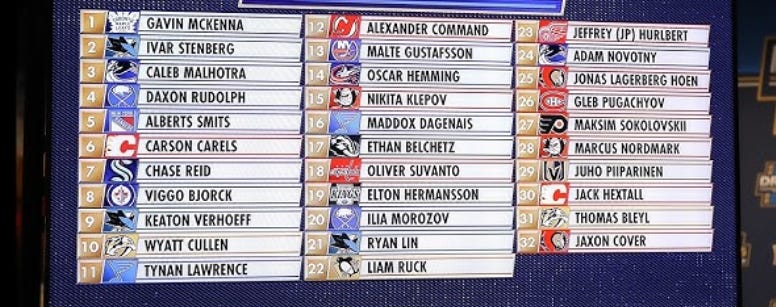
The NHL has yet to announce when or where the 2027 draft will be held.
Or, more importantly, whether it ever will return to the format under which most of the floor in the venue hosting the event is taken up by tables occupied by a dozen or so personnel executives and scouts from every club.
In 2025, the league adopted a decentralized format, under which team officials worked out of their home cities and the only people at the site were league officials, fans and some top prospects.
Some team officials prefer that, perhaps because there are no travel costs involved and no danger of someone at a nearby table eavesdropping on conversations they would prefer to keep private.
Those are legitimate issues, of course, but when the decision-makers for every team spent a day or two in a confined space, the prospects of negotiating trades almost certainly are enhanced. And, of course, there’s always the possibility that those executives would cross paths in a social setting or at one one of the league meetings that used to be part of draft weekend.
High-impact trades have great appeal for a lot of fans, and doing everything possible to make them more viable could only enhance interest in the draft – and the sport.
Secondary observation: The league should return to having Montreal be the site of the draft every year. Allowing fans from around North America to experience the draft in their city obviously is nice, but the draft was a fixture in Montreal from 1963 through 1984 and doing it there just feels right.
***
I’m not a gambler. I don’t fill out a bracket for the NCAA basketball tournament or pick one of those squares guessing at the score at various points in the Super Bowl.
I believe I’ve mentioned in this space that one summer when I was in college, I lost $23 betting on horses at a track in West Virginia. Might as well have been $23 million, considering the enduring impression that experience made on me.
Anyway, while I certainly am not the target audience for the gambling interests that have become so pervasive in pretty much every major sport (and probably a lot of minor ones) in recent years, there clearly is a huge audience for wagering on everything from who will win the World Series to whether the next pitch thrown in a particular game will be a slider.
I have no issue at all with those who gamble for entertainment and do so within their financial means, but it’s hard to deny that there is enormous potential for betting-related scandals that would taint the integrity of the sport it involves.
Now, there is zero chance of going back to the days when someone wanting to place a wager on a sporting event had to reach out to the local bookie instead of a megabucks online entity, That means it’s almost inevitable that at some point, there will be a train wreck of a betting scandal that could do irreparable harm to a lot of lives and even a sport itself.
***
The communications business is always evolving and, in a lot of ways, bears scant resemblance to the industry I entered some decades ago.
Back then, newspapers were the dominant source of information in most places and local TV stations had large and loyal followings.
Change often translates to progress, and that is the case with much of what’s gone on with the media over the years. As an old-time newspaper guy, I hate to see how print media have faded far into the background for most people, but the instant availability of things like breaking news and weather information is a real boon for society.
Conversely, there are some habits that reporters and others in the business have picked up that, given my background, I find to be particularly grating.
Exhibit A: It’s almost a given that in virtually every interview scrum – and a lot of one-on-one sessions – someone will ask a player or coach a question that begins “How proud are you …” or “How happy are you …” or “How excited are you ...”
Simply put, it’s not a reporter’s job to tell an interview subject how he or she feels about anything. Our role is to get that person to tell us how they feel, and why they feel that way.
I suspect that most people aren’t bothered by that nearly as much as I am, especially when it has become so widespread, but hearing a question framed that way always makes me wince.
Almost as much as dropping $23 at a West Virginia racetrack did.
(We’ll save Exhibit B – exchanges with an interviewee that begin “Talk about … – for another time. But suffice to say that if an interviewer isn’t sufficiently knowledgeable [or interested] to formulate a meaningful question about the issue at hand, remaining silent would be prudent.)
Dave, if you would like, I would be happy to share a few of the rabbits in my backyard for you to yell at. And my garden would certainly be a better place for it.
I totally enjoyed reading this. It is vintage Dave Molinari and I couldn’t agree more with everything you have written. I miss the old days of reading an actual print newspaper. Even the black ink stain on my fingers.
And I am really glad that we don’t see Mario Lemieux or Sidney Crosby promoting Betting Sites ala Wayne Gretzky “I never split nines”.
I won’t bother to ask “How does this gem of an article make you feel”? But I will tell you that it makes me very happy!